
Man Cave Setup Guide: Plan a Room You’ll Actually Use
begin with how the setting will be used, then protect the setting needed to move, play, sit, and maintain it. Décor comes after the approach—not before it.
A workable man cave starts with one primary use: cue sports, home theater, bar-led hosting, or gaming. select that anchor first, map the usable setting around it, then add chairs, lighting, audio, cabinet setting, and secondary entertainment in that order. A setting can look finished and still feel awkward if circulation or sightlines were never planned.
1. Start with the setting’s primary use, not its décor
The first decision is simple: what is the setting for on an ordinary week? A man cave can support several activities, but it needs one primary use to make the rest of the design coherent. A cue-sports setting asks for a different floor approach than a theater setting. A bar-centered space needs a different flow than a gaming space. Pick the use that should still function when the space is busy.
Write a short usage brief before shopping. Include who uses the space, what they do there, what needs to stay accessible, and what can remain secondary. This prevents a familiar mistake: choosing a theme, a display, or a piece of furniture first, then discovering that the rest of the space has to function around it.
| Primary use | Anchor to plan first | What the space must protect |
|---|---|---|
| Cue sports | Table and its use zone | Clear movement around the table, cue handling, and chairs outside the play path |
| Home theater | display and chairs layout | Sightlines, comfortable chairs, cable routes, and controlled lighting |
| Bar-led hosting | Bar furniture and serving path | Standing space, chairs, cabinet space, and a route that does not cut through the social area |
| Gaming | Screen or play station | Viewing distance, chairs, power, audio, and cabinet space for accessories |
Name one primary use and no more than two secondary uses before you compare tables, furniture, games, or wall décor.
2. Check the space before you buy the anchor
A product photo cannot tell you whether an item will work in your specific space. Before choosing an anchor, make a measured floor plan and mark doors, stairs, windows, columns, vents, outlets, and anything that limits placement. If measurements or installation requirements are unclear, pause and verify them with the manufacturer, installer, or a qualified local professional.
Use three paths when reviewing the layout. The circulation path is how people enter, leave, and pass through. The use path is the space required to play, recline, watch, or sit comfortably. The service path is how you reach cabinet space, controls, cables, and equipment after the space is furnished. These are planning checks, not universal building-code measurements.
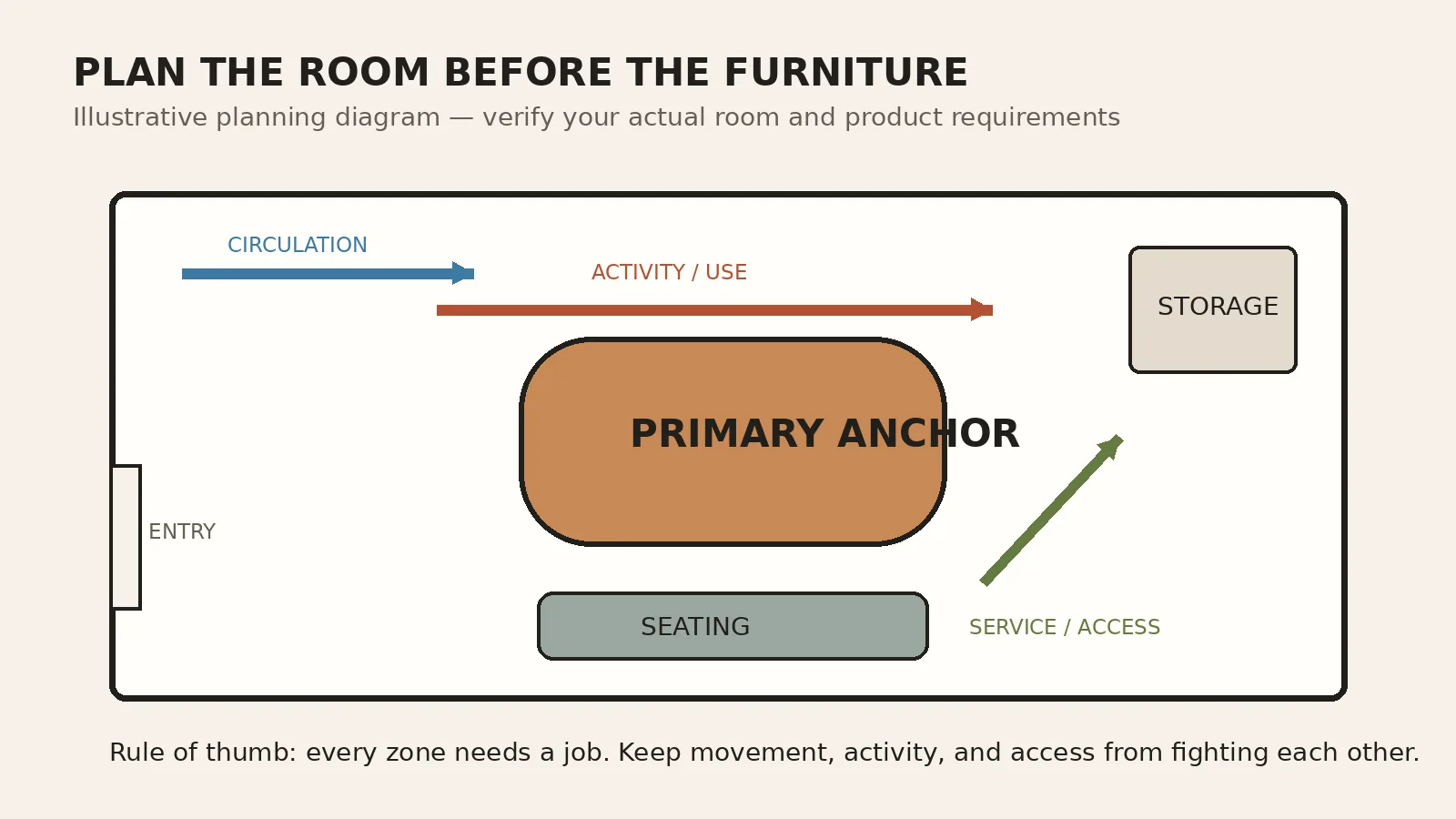
Basement, garage, and spare-space constraints are not interchangeable
A basement may need an honest check of moisture, ventilation, ceiling conditions, electrical capacity, and access before fixed furniture arrives. A garage may add temperature, dust, vehicle access, and audio-transfer questions. A spare space can be easier to furnish but may still be limited by door swings, cabinet space, and nearby bedrooms. Local requirements differ, so verify electrical or structural work with the appropriate local authority or qualified professional.
- Measure the usable place, access route, and door openings.
- Mark the proposed anchor, seating, cabinet space, and walking routes.
- Confirm power, ventilation, moisture, sound, and installation needs for the property.
- Keep a product specification sheet with the plan; do not rely on an image alone.
Do not buy the anchor until you can place it on a measured plan and still see how people, equipment, and cabinet space will be reached.
3. Build the setup in the order that protects comfort
The buying order matters because early purchases place the limits for everything after them. Start with the room conditions and the anchor. Then resolve seating and lighting. Add screens, sound, and cabinet space once their placement is clear. Finish with secondary games, memorabilia, and decorative details. This approach may feel less dramatic than a themed shopping list, but it gives each item a job.
Comfort is not just soft seating. It is the ability to sit without blocking a route, watch a screen without glare, play a game without moving furniture, and put equipment away without turning the room into cabinet space. A smaller room can feel more considered than a large room full of items that compete for the same area.
| Phase | Decide now | Delay until the room proves it needs it |
|---|---|---|
| Room + anchor | Primary activity, layout, access, fixed placement | Theme pieces and extra furniture |
| Comfort + lighting | Seating positions, task lighting, ambient lighting | Secondary display pieces |
| Entertainment + display | Sound, screen, games, practical cabinet space | Anything that reduces usable movement |
Fix the anchor and paths first. Secondary décor should never force a compromise in how the room is used.
4. Choose furniture by use and construction, not by a themed checklist
“Premium” is not one feature. Compare each piece by its stated dimensions, materials, installation requirements, intended use, serviceability, and manufacturer documentation. A table, bar cabinet, theater seat, or cabinet space unit belongs in the room only if it supports the plan already on paper.
For table games, look beyond the finish and ask what the manufacturer states about construction, playing surface, delivery, assembly, and maintenance. For seating, compare placement, recline or motion requirements where applicable, cleaning needs, and the view from each position. For bar furniture, think about standing space, serving flow, and cabinet space access. For display furniture, decide what it stores before it earns wall space.
Kings Cave curates game-room categories including billiard tables, shuffleboard tables, arcade games, theater seating, home bar furniture, and garage equipment. That is useful only after the room’s purpose is clear. Do not use a product category as proof that an item fits your space; check the specific item’s current specification sheet and ask the seller to clarify a missing detail.
Compare manufacturer details and installation needs, not just style. If a material, dimension, or service requirement is missing, get it clarified before ordering.
5. Use lighting, sound, and cabinet space to make the room usable after dark
Lighting should support an activity, not simply brighten a room. Task lighting helps at a table, bar, desk, or cabinet space area. Ambient lighting makes seating comfortable without washing out a screen. Display lighting can highlight memorabilia or wall art, but it should not create glare where people watch or play.
Sound needs the same planning discipline. Decide where screens, speakers, controls, and cable routes will live before buying fixed furniture or closing a wall. In a basement or garage, sound transfer and the room’s construction deserve special attention. Do not make acoustic or electrical claims from a generic guide; use the product instructions and qualified local help for the actual installation.
Storage is the quiet test of whether a setup works. Controllers, games, accessories, cleaning supplies, and bar items need a place that is easy to reach without sitting in the activity zone. A wall can carry display storage, but only if it does not make the room feel narrower or interrupt seating and screen sightlines.
| Layer | Its job | Question to answer |
|---|---|---|
| Task lighting | Make a specific activity visible | What action needs light here? |
| Ambient lighting | Keep the room comfortable to occupy | Will it create screen glare or harsh shadows? |
| Display lighting | Support a wall, collection, or bar feature | Does it add meaning without distracting from use? |
| Storage | Keep gear accessible but out of the way | Can it be reached without crossing the activity area? |
Assign every light, outlet, cable route, and storage zone a job before installation. If it has no job, it is probably noise.
6. Set up a small room, basement, or garage in phases
A small man cave does not need to imitate a larger room. It needs a narrower brief. Choose one anchor, keep the circulation path clear, use seating that suits the actual room, and resist turning every wall into display storage. A small gaming space may work better with one screen and focused seating than with several competing games. A compact bar area may work better as a serving point than as the room’s main destination.
For a basement or garage, start with the room’s condition before the theme. Confirm what the space can safely support, how furniture will enter, where power and ventilation are available, and how sound will affect the rest of the home. Then build in phases. Use the room after each phase. That real use reveals whether you need more seating, better lighting, different storage, or simply less furniture.
Finish one usable layer, live with it, and then add the next. A phased setup protects the room from expensive clutter.
Use man cave ideas as prompts, not as a shopping list
Useful man cave ideas begin with a personal routine: a pool table night, a movie with friends, a quiet gaming session, or a bar conversation. Consider what must happen in the space before choosing a theme. A big display can matter, but it is not automatically the center of the experience. The same is true of sports memorabilia, lights, and wall art: each item should support the activity rather than compete with it.
Many man caves borrow the language of the “ultimate” setup. That word is not a requirement and it does not replace a clear brief. A complete space has a purpose, a usable layout, and a personality that matches its owner. If the perfect version of the space is unclear, start with one primary activity and leave open area for change. In a basement, garage, or spare space, that restraint is especially valuable because access and conditions can shape every later decision.
Before a purchase, ask one final question: does this item help create the type of evening you want, or does it simply look like it belongs in a man cave? That distinction keeps the setup focused. It also gives you permission to stop when the space functions well instead of adding furniture, games, or décor merely to fill walls.
Frequently asked questions
What should go in a man cave first?
Start with the room’s primary use and the anchor that supports it. Map the anchor on a measured floor plan, then resolve circulation, seating, lighting, and storage before buying secondary games or décor.
How do you set up a small man cave?
Give a small room one primary job. Keep the path through the room clear, choose an anchor that fits the measured space, and use lighting and storage that do not compete with seating or screen sightlines.
Does a basement or garage need special planning?
Yes. The property-specific checks can include access, moisture, ventilation, electrical capacity, sound transfer, and local requirements. Verify the actual room and any installation work with qualified local help rather than relying on a generic setup guide.
Once the room plan is set, compare the game-room furniture categories that match the anchor—not the other way around. That keeps the space useful long after the theme has stopped feeling new.
A man cave does not need a complex system to feel finished. Choose the size of each piece from the measured layout and the activity it supports, then leave enough open setting for the space to remain easy to use.
[A VERIFIER] Product-specific dimensions, materials, installation requirements, and availability must be checked against the current manufacturer specification sheet for the specific item. Building, electrical, ventilation, and structural requirements must be verified for the property with official local sources or qualified professionals.