
Game Room Flooring Guide: Picking the Right Floor
The floor under a game room has to do three jobs at once — stay comfortable during long sessions, shrug off spills, and carry the weight of heavy tables. Here is how the main flooring types compare, and how to match one to the room you are actually building.
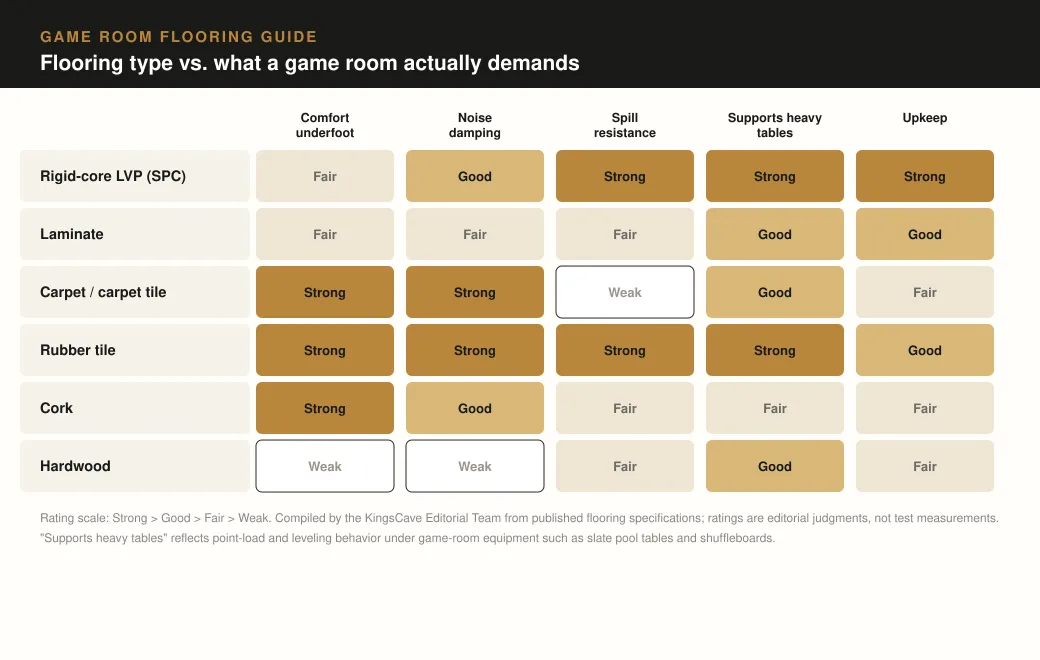
For most game rooms, rigid-core luxury vinyl (LVP) is the practical default: it handles spills, foot traffic, and the point load under a heavy table while staying easy to clean. Choose carpet or cork if underfoot comfort and noise control during long gaming sessions matter more than water resistance.
01What makes game room flooring different
A game room floor is judged differently from a bedroom floor. It sits under concentrated weight, takes heavy foot traffic on game nights, and meets the occasional dropped cue or spilled drink. So the surface has to be durable, comfortable, and simple to clean — three demands that pull in different directions.
Fact: those three pressures — load support, sound control, and spill resistance — show up in every room of this kind. Inference: because no single material wins on all three, your choice should consider which one dominates. Whether you host poker nights, run an arcade, or build a family game room, the floor you install helps create the look and feel of the whole design. That is the point of this game room flooring guide: match the surface to how the room gets used, not to a generic durable-options list.
- Rigid-core LVP balances spill resistance, durability, and heavy-table support better than most options.
- Carpet and cork lead on feel and sound for long gaming sessions, but lose ground on spills.
- Any surface under a slate pool table has to carry a concentrated point load, not just a spread-out weight.
02Game room flooring options compared
Six flooring types cover almost every game room build: rigid-core luxury vinyl, laminate, carpet, rubber tiles, cork, and hardwood. Each option offers a different mix of comfort, quiet, and durability. The table below rates them on the criteria that decide the room.
| Flooring type | Comfort underfoot | Noise damping | Spill resistance | Supports heavy tables | Upkeep |
|---|---|---|---|---|---|
| Rigid-core LVP | Fair | Good | Strong | Strong | Strong |
| Laminate | Fair | Fair | Fair | Good | Good |
| Carpet / carpet tile | Strong | Strong | Weak | Good | Fair |
| Rubber tile | Strong | Strong | Strong | Strong | Good |
| Cork | Strong | Good | Fair | Fair | Fair |
| Hardwood | Weak | Weak | Fair | Good | Fair |
Vinyl and laminate: the durable workhorses
Rigid-core luxury vinyl plank is a dense stone-plastic core under a printed top layer. Residential planks commonly carry a 12 to 20 mil wear layer, the part that resists scuffs over the years (vinyl flooring reference, accessed July 2026). Modern rigid-core vinyl is available in many wood-look colors and designs, clicks together over most subfloors, and is easy to install and maintain. Laminate looks similar and costs less, but its fiberboard core is more sensitive to standing water, so it rates only fair on spills.
Carpet, cork, rubber, and hardwood
Carpet and cork are the comfort picks — soft to walk on and naturally good at absorbing sound. Cork feels warm and springy, which makes it a nice fit for a lounge. Rubber tiles are the quiet all-rounder, strong on feel, sound, and spills at once, which is why they turn up in home gyms and heavy-use spaces. Hardwood brings a natural, high-end look but is the least forgiving choice here: it dents, it echoes, and it dislikes moisture.
03Matching flooring to your game room equipment
The equipment you own should decide the floor before aesthetics do. A game room built around a slate pool table has a load problem most flooring guides often skip: the weight lands on a handful of leg contact points, not the whole footprint.
Fact: a nine-foot slate pool table is commonly cited at roughly 800 to 1,200 pounds once the slate bed and frame are counted (billiard table reference, accessed July 2026). Inference: spread across a few legs, that concentrates enough point load to dent soft floors like cork or thin carpet over time. Recommendation: under a heavy slate table, favor a rigid-core or laminate floor over a soft one, and use load-spreading cups if the table sits on carpet.
Leveling is the second equipment constraint. A slate pool table and a shuffleboard both need a floor that holds a flat, stable plane so play stays true — an uneven or spongy surface makes precise games frustrating. If your build centers on professional slate pool tables or a tournament shuffleboard, a firm, level floor matters more than plushness.
04Comfort, sound, and long gaming sessions
Comfort and quiet matter most in rooms built for time on your feet. Long gaming sessions, poker nights, and arcade play all reward a surface that feels soft and is slow to echo.
Carpet, cork, and rubber lead here because they absorb both impact and sound. A hard option like laminate or hardwood reflects more sound and tires the legs faster, though an area rug over rigid-core LVP is a common middle path — you keep the easy-clean surface and add a softer feel where people stand. Recommendation: if the room is mainly a lounge and gaming area rather than a wet bar zone, an ideal setup leans toward a softer feel, and lets a rug do the work.
05Spills, cleaning, and durability
Spill resistance is where a game room floor earns its keep. Drinks, condensation from a bar area, and everyday use all land on this surface, so easy cleaning is a real feature, not a luxury.
Rigid-core LVP and rubber tiles are the most durable picks for a room with a bar, since both wipe clean and resist standing moisture without much upkeep. Carpet is the weakest on spills and the hardest to maintain in a busy space. Inference: if your room pairs a bar with a game area, spill resistance should outrank feel in your decision, because a stained or warped surface undoes the whole look. Recommendation: whatever type you choose, match the wear rating to your daily use and add felt pads under stools and furniture — that unique bit of care keeps the room durable and keeps game nights fun for years.
06Game room flooring: frequently asked questions
What flooring should you choose for a game room?
There is no single answer for every room. Rigid-core luxury vinyl is the most balanced choice because it handles spills, foot traffic, and heavy-table support while staying easy to clean. Pick carpet, cork, or rubber instead when comfort and noise control matter more than water resistance.
Can a game room floor support a slate pool table?
Yes, but the concern is point load, not total weight. A nine-foot slate table is commonly cited near 800 to 1,200 pounds, carried on a few contact points. Rigid-core vinyl, laminate, or a structural subfloor handle that well; on soft floors such as cork or carpet, use load-spreading cups under the legs.
Is vinyl or laminate better for a game room?
Rigid-core vinyl resists standing water and spills better because its core is not wood-based, which suits a room with a bar. Laminate costs less and looks similar, but its fiberboard core is more sensitive to moisture, so it fits drier lounge or arcade spaces.
What flooring is quietest for long gaming sessions?
Carpet, cork, and rubber tile damp sound most effectively because they absorb impact rather than reflect it. On a hard floor like laminate or hardwood, an area rug in the seating zone is a simple way to cut echo and add comfort where people stand.
Does a game room floor need to be level?
For precise games it does. A slate pool table and a shuffleboard both play truest on a firm, level plane, so a stable floor keeps play accurate. Soft or uneven surfaces can throw off leveling and make setup harder.
How do I protect a game room floor from spills and wear?
Choose a spill-resistant type such as rigid-core vinyl or rubber tile near a bar, wipe spills quickly, and match the wear rating to your foot traffic. Felt pads under stools and load cups under table legs reduce dents and scratches over time.
- Billiard table — slate bed construction and table dimensions (accessed July 2026).
- Vinyl flooring — wear layer and construction reference (accessed July 2026).
- Flooring type ratings compiled by the KingsCave Editorial Team from published manufacturer specifications, July 2026.